United Nations climate talks enter their originally-scheduled final day on Friday

with envoys divided over the obligations placed on rich and poor countries, how to spark deeper cuts in fossil-fuel pollution and what their long-term goal should be.
The delegates from 195 nations negotiated into the early hours of the morning, after working through most of the night on Thursday. They’re trying to narrow options in the text of the agreement that range from the amount of global warming the world should tolerate to how countries should review their efforts to reduce greenhouse gases.
A final draft agreement has been delayed until Saturday, Agence France-Presse reported through its Twitter account, citing an official it didn’t identify.
“We cannot fail now,” Miguel Arias Canete, the European Union climate commissioner, told reporters at the meeting in Paris. “We will not accept a weak or minimalist deal.”

The delegates are trying to forge the first truly global deal to rein in carbon pollution. They aim to arrest rising temperatures that this year are set to be the highest on record. The limits on fossil-fuel emissions would bring upheaval to energy policies everywhere as governments tilt their economies toward renewables and away from coal, oil and gas.
Late Thursday, French Foreign Minister Laurent Fabius published a new draft text that narrowed the gaps between nations. It’s made up of the enduring agreement that would start in 2020, as well as a so-called decision text that makes shorter-term provisions.
The document contained 50 pairs of square brackets indicating specific areas where language isn’t agreed, down from 367 on Wednesday and 940 on Saturday. There are now just six instances where an entire clause has multiple options, down from 19 on Wednesday and 36 on Saturday.
“The crunch issues have not been solved yet, so there is much work to be done this night and tomorrow,” said Yukari Takamura, professor at Nagoya University in Japan, who has been following climate talks for 15 years.
Work Plan
Fabius told envoys they should negotiate privately into the morning to reach convergence. Delegates now must reach agreement on bracketed items. In six key places, one clause must be written from two or three options in each place.
The envoys are homing in on a deal that would take effect from 2020, capping the global temperature rise since pre-industrial times to 2 degrees Celsius (3.6 degrees Fahrenheit). It is likely to acknowledge the need to strive for 1.5 degrees, a key demand of the countries most vulnerable to warming, including island states imperiled by rising seas.

Some 185 nations have already submitted voluntary national "contributions" rather than the internationally legally binding targets that were central to the 1997 Kyoto Protocol. The previous treaty bound only rich countries to cut carbon emissions. Envoys are debating when to review those pledges, which are mostly for 2030, but include some for 2025. The latest text would see countries "confirm or update" their pledges by 2020, with a "global stock-take" of efforts held in 2023.
There are also differences over how much information countries must disclose about their efforts. Indian Environment Minister Prakash Javadekar on Dec. 9 said he favored “two different systems of transparency” one for the rich nations and another for all the rest. Todd Stern, the U.S. climate envoy, said he can’t accept “a bifurcated system.” Options resembling both those positions remain in the latest text.

Other issues up for debate include whether to quantify financial aid from developed to developing world. The rich nations pledged in 2009 to deliver $100 billion a year of aid to poorer ones by 2020. There are also questions about how a “Loss and Damage” mechanism that would compensate the least developed countries for the consequences of rising seas and stronger storms that they’re already seeing. Rich countries want to avoid any notion of liability or of compensation.

Aside from the temperature goal, envoys are trying to work out another way to frame the long-term aim of their efforts. That’s a key demand of companies which must help deliver the required emissions cuts.
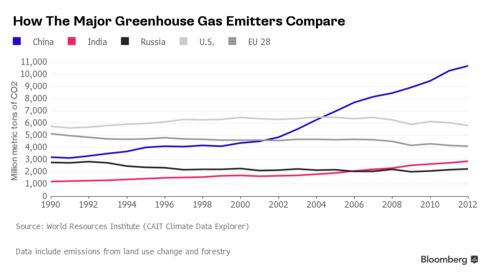
This week, seven business organizations representing thousands of companies around the world signed a letter drafted by the Prince of Wales’s Corporate Leaders Group urging envoys to define “a clear and specific long-term emissions goal” with national reviews every 5 years to scale up carbon-cutting efforts.
“With such a signal business and investors will be able to scale up the already considerable investments and actions they are making and deliver trillions of dollars of investment over the next decade,” the groups said.
Patrick Abboud
ebook sale "Classified Marketing Secrets PLR" Buy Now For $1.95

No comments:
Post a Comment